Sobre la suspensión [estudio] for vibraphone and live electronics (2024) commissioned by Miquel Bernat

This piece is an etude on stillness and contemplation. Following the principles of deep listening and kinetic immersion, each event comes out of the musician’s inner pulse, taking breathing as the steady rhythm. The vibraphone is expanded with the electronic aftersound using the alpha scale (developed by Wendy Carlos) creating a consonant/dissonant landscape. Departing from the notion of simplicity as an aesthetic principle, Hara Alonso creates an liminal, atemporal space.
Premiered at Palau de la Música de Barcelona (Petit Palau) on the 27th february 2025
Listen here [excerpt] live from Casa Mateus:
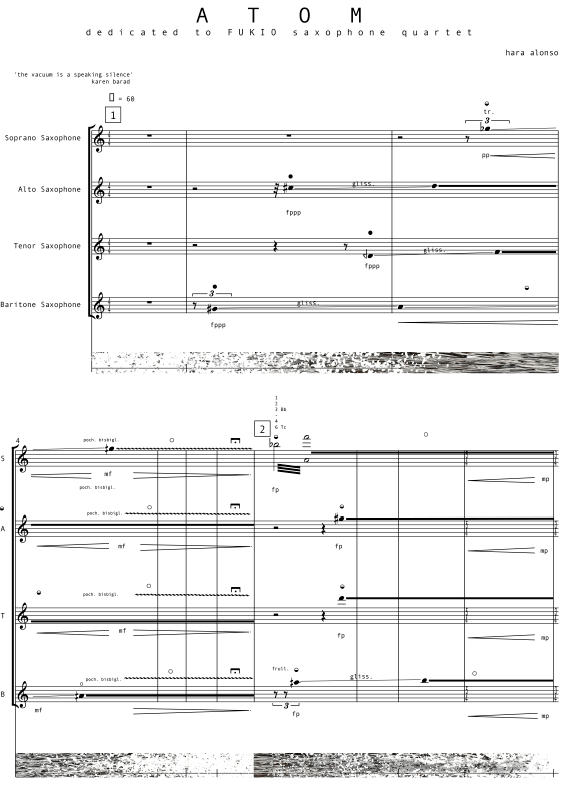
ATOM (2024) commissioned by Fukio Saxophone Quartet
[…] the vacuum is a speaking silence,
a quiet cacophony of different frequencies,
pitches, tempos, melodies, noises, pentatonic scales, sirens, quarter tones, allegros, ragas, beatbox, shrimpers, whines, screams are treated through the silence,
ready to erupt, but simultaneously crushed cut by a disruption. Dissipating, dispersing…
there would be sound into non being, an undetermined symphony of voices
Inspired by the lecture ‘On Touching: The Alterity Within’ by the American feminist theorist and physicist Karen Barad, this piece attempts to translate the universe ontological inseparability of intra-acting agencies into sound by means of sonic, kinetic and proprioceptive immersion. Emerging and echoing the electronic part, the saxophones establish a dialogue with the computational composition procedures by applying the same stochastic principles of alteration and variation of patterns in a micro and macro level. By stretching the idea of concert to a more installative and spatial set up, this piece intends to invoke a boundless timespace. Through trompe l’oeil and acoustic illusions, the audience is invited to surrender to the physical and acoustic experience.
Fukio saxophone quartet invited 4 composers from all around the world to create new works for their 15 year anniversary concert: “Fukio Saxophonquartett + Electronics / 15 Jahre Jubiläumskonzert”. The project took place at the Alte Feuerwache in Cologne with a dress rehearsal on the 21st of March and a performance on the 22nd of March 2024. It had the financial support of Kunststiftung NRW, Musikfonds, ON Cologne and Kulturförderung-Stadt Köln.
]
Listen to the live performance here:
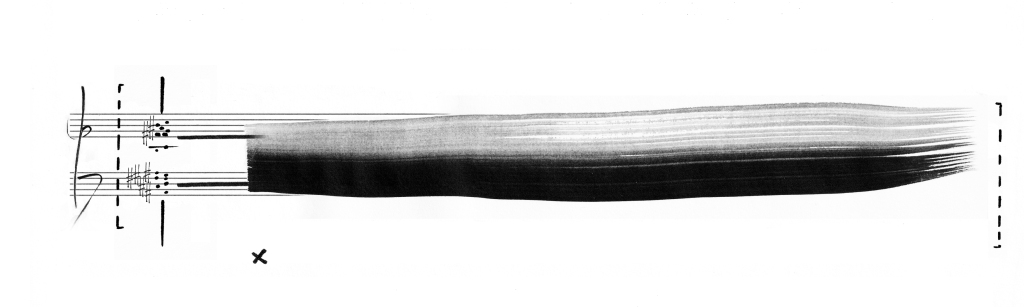
SOMATIC STUDIES FOR PIANO (2020)
somatic
adjective MEDICAL specialized
UK /səˈmæt.ɪk/ US /səˈmæt.ɪk/
relating to the body as opposed to the mind.
ABOUT
To learn how to play an instrument, it’s a long life process. The practice shapes through the years by assimilating knowledge at different levels. Each piece of music, each improvisation requires a specific technique, a specific attention, a specific listening. It took me many years of practice to learn how to listen. It took me many years of practice to learn how to be aware of my body.
I used to play piano many hours during my adolescence, it was my favourite activity. At some point I got bad back problems. I was recommended to take yoga and tai-chi lessons, so I did. Those were my first encounters with my body, learning how to breath, how to feel the muscles, how to balance.
In 2014, by chance, I started to practice contact improvisation, an improvised dance technique that uses sharing weight as fundament. This practice opened up the possibility to communicate my body with other bodies and the space. 2Out of some improvisation session I started to experiment those physical sensations while playing piano. I began to dance with the piano, to explore it as an object in space. This experience changed my musical practice. It was a revolution in my listening and my body.
During those years I had the chance to collaborate in many dance projects, working hand in hand with dancers and choreographers and learning their compositional tools. The dance practice is very situated, defined by the bodies of the dancers, by the space. They learn the choreography by motion, not by notation (in the traditional sense), therefore the memory is in the body. I got very captivated by the possibility to understand music notation as a choreography.
In the last years I practiced body techniques such as Body Mind Centering and Feldenkrais. Those methods allowed me to work with deep corporal sensations and translate them into my piano practice. Therefore I started to use physical gesture as composition element, decentering the focus from the front (the score, the vision, the brain, the fingers), to the sphere (the whole body, the organs, the peripersonal space).
There is a direct transference during the piano playing between the body and sound, the quality of the sound and physical movement which produces it is inseparable. The composition of the ‘Somatic Studies for Piano’ is an approach to embody music content creating a music notation. That is to integrate the evocative and suggestive power of corporal sensation as indication for the performance in order to align attention, intention and sensation.


NOTES FOR THE PERFORMANCE
What happens between the notes?
These pieces are ‘studies’ because they intend to explore specific basic physical elements in the piano playing such as gravity, antigravity, repetition, etc. The aim is to cultivate awareness of the body sensations during the practice, therefore the goal is the process, not the result. Before and during your study try to breath deep and connect with your bodily presence. Feel your feet connected to the ground, your hips rooted in the chair and your upper body flexible and expanded. Immerse yourself in the feeling of the movement. Give yourself the chance to explore it deeply, slowly. The difficulty of the scores is not in the notes but in having a high level of corporeal consciousness. Therefore it’s about what happens between the notes, how one enters and exits the key.
Turista de interior. Revista de procesos de isla, Volumen 8 [ publication, graphic scores & sound pieces ]
The 8th volume of Inland Tourist. Revista de procesos de isla has the participation of the philosopher and poet Sandra Santana (Madrid, 1978) and the pianist and composer Hara Alonso (Astorga, 1990). On this occasion, the concept of the island has turned towards a more symbolic layer that includes time as a fundamental nucleus; island-time as the temporary space of being.
Sandra Santana and Hara Alonso maintain an epistolary relationship that is embodied in the magazine through poems and scores. Solar. Acción Cultural fosters this form of relationship by giving time and space to the creators so that the processes of reflection expand, grow and be faithful to life. Thus, the magazine turns towards the metaphor through poetry, drawing and sound. The conjunction between these forms of creation treats the concept of the island as the very act of writing, both literary and musical (score).
It is an island time, a time suspended from productive time.
As in each volume, the editorial section is accompanied by a photograph of Mataparda and the global design is made by Racso Zehcnas.
 hara alonso